
How to Get the Crown of Life
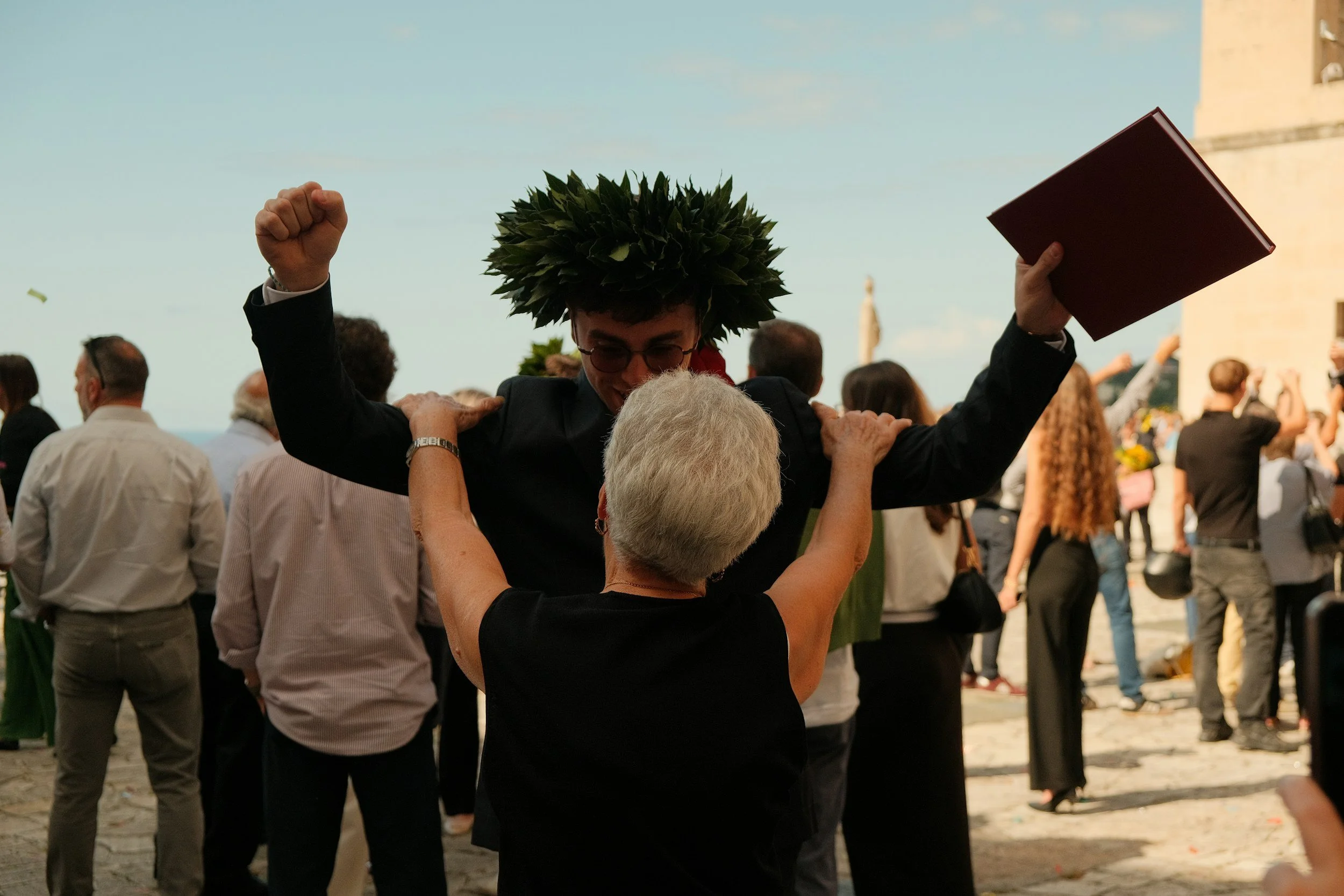
Man celebrating with a laurel crown on his head
One of the amazing things about the up to the second news cycle today is how we can be aware of the wall to wall suffering in the world and yet still be surprised by our own. We are surprised by the big things, the diagnoses, the divorces, the deaths and the little things, insomnia, dead spark plugs, and that one red light that you always seem to catch. You would think given our constant stream of bad news we would know how to respond to hardship or at least expect it. Yet suffering always seem to catch us unexpectedly, flat-footed, and unprepared. Much of the time all we can do is sputter questions like "Why this, why now" and "What in the world am I supposed to do next?"
Maybe the reason why we are so surprised by our own suffering is we spend too much time on the other side of the internet, the social side, because we find the exact opposite of suffering: seeming endless highlight reals of other people's lives. Where that guy seemed like a real solid guy in real life, and then he got that car and became insufferable. Then when good things happen to us, we just as quickly run to the socials to perform the same insufferable brag. Trials come in many forms, and we could sure use some wisdom in how to deal with them.
Enter James chapter 1. James begins his letter with realistic expectations for life. He doesn't sit on the fence with "if you find yourself in trials," like he is unsure if you will ever experience this. He tells us what to do when we find ourselves in trials of various kinds. And it is exactly what we need.
Endure Trials with Pure Joy
James chapter 1 opens with the most turn-things-on-their-head statement he could. He isn't unique in this (see 1 Peter 1), but James is shocking here in telling us to rejoice in our trials of various kinds.
Now, there are a number of ways to misunderstand this. One is to assume that James is telling us to smile and belly laugh when the cancer diagnosis comes over the phone. That isn't it. For one, joy is distinct from happiness. Happiness is an elevated mood dependent on the moment, while joy is confident and dependent on the God who brings the moment. Joy, a settled conviction that God is for you, can be constant because He is. Second, we can see from the example of Jesus that this isn't what James is telling us. When Jesus comes to the tomb of Lazarus, He is weeping. Jesus is sad. He is not happy that Lazarus is dead, nor is He cracking jokes trying to make everyone else stop crying around Him.This shows us what is meant here in James. It also shows us not to automatically whip this verse out trying to fill the silence in someone's grief. There are times to, but it isn't as often as we think.
I think we can also make a mistake when we think that trials are only unpleasant things. As one commentator pointed out, riches, prosperity can be just as much of a test and trial of our Christian life. Riches can prompt us to pride! Peaceful family relationships can lull us into prayerlessness for them. Viewed in this way, trials are absolutely EVERYWHERE! It is a good thing God has a purpose in them, if we will but react to them rightly.
Yet the point remains that we do at least have some reason to have joy in the midst of testing of all kinds because it does have a purpose, a purpose to make us persevere or have steadfastness. This steadfastness isn't the image of a mighty tree standing still in the midst of the storm. We aren't passively standing there. Instead, as one commentator put it, we are "successfully carrying a heavy load for a long time." But we aren't just undergoing trials just to carry a heavy load like we trying to be Navy Seals or something. The steadfastness itself is leading somewhere, namely, maturity. What does that look like?
I came across an excellent article talking about real life and how it forms us, and he had this wonderful illustration of struggling to cut down a 100 year old maple tree at 11 years old:
What you want to tell your folks, over dinner, is that me—their first born–well, lucky them. I cut down a tree. So you swing at the tree and it hits back with all its immovable ardour. Over and over. And what it does is change you. Your mind. Your grip. You imagine this is why lumberjacks are so lumbering. The trees and the axe shape them.
These things, the changes, you can’t buy them. You can’t simply add them to your life. They’re grown into. Like all Good things.
You want to be Good? Healed? Whole? There are no shortcuts. Chainsaws won’t get you there, if you know what I mean. Healing can’t be made efficient, it can’t be optimized. It has to be lived, worked into your body over time. A body slowly learning to love what is Real and being transformed by the process."
In other words, we are shaped by trials, IF we let them. That's why verse 4 is a command "LET steadfastness have its work." You hold that axe. Keep swinging. Don't swap it for that chainsaw you think will work better. Don't numb yourself through your life. God told you to swing the axe. Don't wish you had some easier tree to work with. This is the one He placed you in front of. He made that tree just for you. It will change you. It will mature you into someone who trusts God so much you receive with joy the next tree God has for you.
But how do you keep swinging that axe? What do you do when the callouses bleed?
The next section tells us.
Endure by Asking for God's Wisdom
So it is one thing to be told that God is doing something with your suffering, but it is quite something else to actually have to go through it. How do we actually suffer/endure trial well? This is where James moves into the second paragraph and tells us that if we lack wisdom, we are to go to God and ask for it without doubting. Obviously, the command here goes beyond just going to God when you are suffering, as we should be praying in all seasons, but it certainly isn't less.
Now, what does it mean to ask without doubting? Does this mean if we ever have a question about God then we are doubters? No! Having genuine, honest questions are welcome! Does this mean that unless we are 100% confident with no wavering, no sin, at all times God won't listen to us? Also no. No one is ever 100% sinless all the time. But that doesn't mean we don't aim for it. We shouldn't come to prayer with the attitude of "Well, nothing else is working, so I guess I'll give this prayer thing a go. Hey, if it doesn't work, I'm not too surprised. That's just my life." That's not very dependent on God, is it?
But I don't think that we doubt that obviously, though. The doubting that we can do is far more subtle in that it doesn't feel like doubting. One time I had some car trouble and, like the naive child I was, I took it back to a dealership to have it looked at. To hear them tell it, my car should have exploded on the way in with all the things that had to be done to it. I took it to a friend after that who actually honestly evaluated the situation, and nearly none of what I was told at the dealership was true. So do you know what happens when I have car trouble? I don't take it to that dealership. I know I won't get the help I need from there. I doubt their ability so much, it doesn't even enter my head to ask them.
And then I turn around and do the same thing to God. I will wake up, walk past my Bible as I snap up my phone, to drink in the news of the day, the stuff I "really need." Some mornings, it never even enters my mind to pray. And I get as much wisdom as I ask for. When I find myself in a season like that, I wonder why I feel so lost and directionless. This verse opens that up.
We don't lack wisdom because God isn't willing to give it to us. The Greek literally calls God the "giving God." He gives wisdom freely, generously, and without guilting you about how you haven't been here in a while. That's what it means for Him to give without reproach. He doesn't fold His arms and go, "Well, well, well, look who finally figured out—again—that Facebook, Reddit, and Cable News don't have any wisdom. Let's see how serious we are about this whole wisdom thing before I dispense any more." That's not God. When we stumble back from our attempts at wisdom, we get treated to the welcoming joy of God Who loves giving you wisdom. Like the Father of the Prodigal son welcomes Him back, so does our God. Just ask!
Then as we round verse 9, it would seem like the text is taking one of those "I see why this book is so hard to outline" kind of turns. But it isn't as out of left field as we might think. The situation in James is that the people are being oppressed by the rich (as we see in 2:6). I would think that there would be people hearing James' wisdom and thinking that there is a much more practical solution: more money. I know we all know that money doesn't buy ultimate happiness, but it does seem to buy a jet ski, and those two things are remarkably similar. It also can acquire medicine and food and housing without having to worry about them anymore. That sounds pretty good!
But James calls us to think a little longer term than that. He calls us to realize that no matter rich you are you are on the clock. I don't mean as a job, I mean as a living person. We all have a fatal diagnosis. Death comes unexpectantly, and for the rich man, James says, it will come in the midst of his pursuits. Can you imagine someone becoming ultra wealthy and finally getting to purchase their dream luxury car and as they are about to sign the paper they pass away at the dealership? Suddenly having all that money becomes a tragedy rather than an asset. Would you desire the rich man's money if you then had to take the rich man's fate? You can buy anything you like, but you can't keep any of it?
Now it is important to point out that this doesn't mean that being rich is inherently bad or unChristian. But it does come with its own temptations. We in this room are far richer than the richest person in the Church during James' time. We've got Amazon, people. We can get anything we imagine delivered to our house by moving our thumbs! We can begin to believe that "give us this day our daily bread" is unnecessary to pray. Perhaps that's why the WiFi goes down so much.
Endure for the Crown of Life
But our last verse tells us what the one who endures receives the crown of life. I think what we are dealing with here is a another name for heaven, eternal life. Let's return to the rich man in the car dealership a moment ago. The reason an image like that is a tragedy is that he stopped just short of his dream. For the Christian, all death can do is usher in that dream. Instead of death stopping you at the door, it opens the door for you.
Death will transport you to the God you have been hoping in, the one Who, as it turns out, has sharpened that axe every time you asked Him. Who has knelt beside you when you were panting and sweating as if you would die, and wiped your brow. You might have thought that it was the gentle breeze that gave you the strength, but you forgot about the prayers you offered—the prayers others offered—that was the real source of strength.
That is the Christian life. We aren't being sent trials to prove we are worthy of heaven but to prepare us to enjoy Him when we get there.
Application
So where does that leave us today? Trials will come in your life. They can be things that are so hard they make you question if there is a God at all. Others are so pleasant they make you not care if there is a God at all. Properly evaluating the trials in our lives comes down to seeing all things as opportunities to grow in our trust of God and seizing those opportunities in prayers to God for wisdom. A steadfast life like that is one that can expect the crown of life at the end.
Now, the world doesn't react to trials like that because they haven't had Jesus enter their lives. Only Christ can bring a transformation like that.