
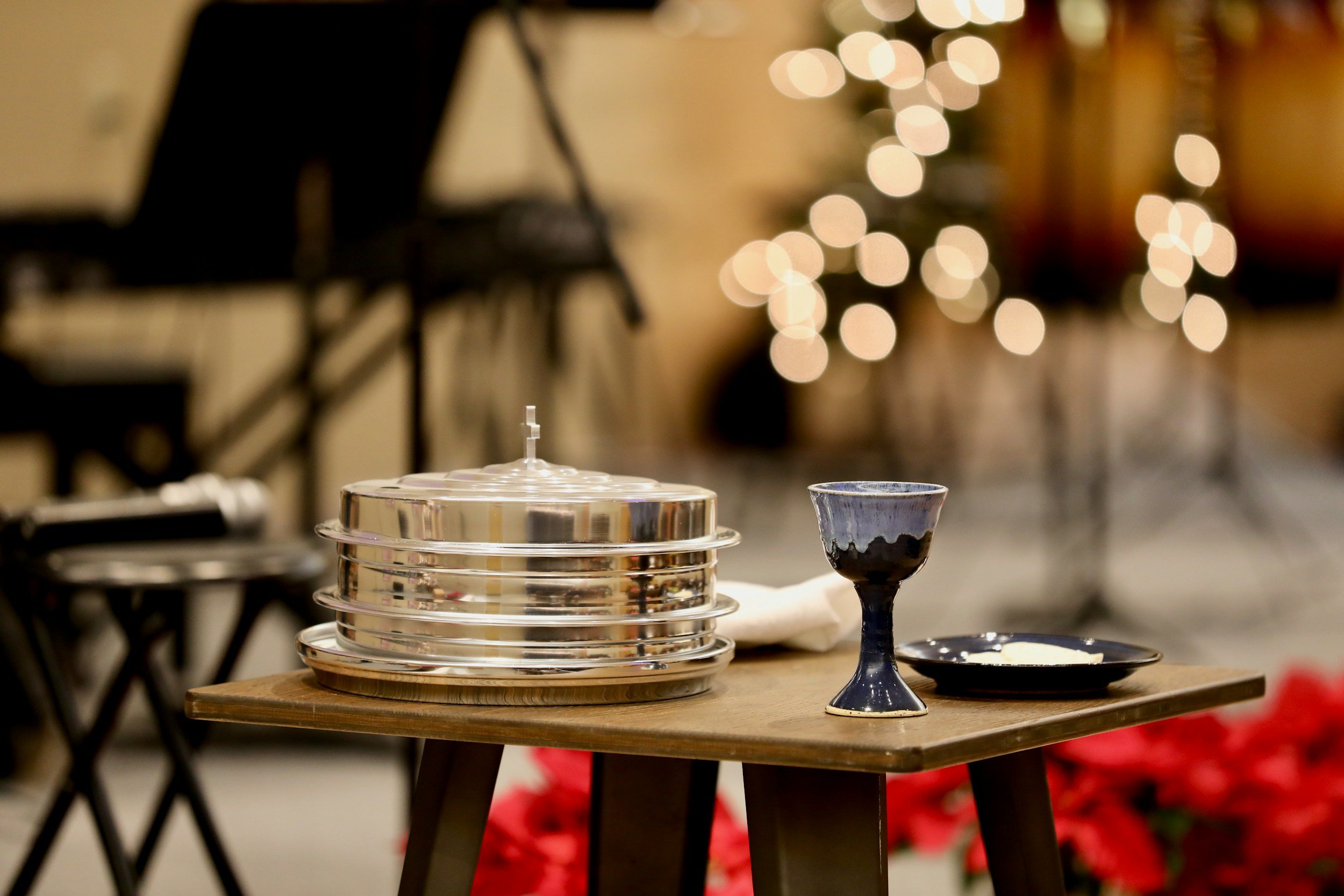
Today we are celebrating the Protestant Reformation. There is a reason we call it a "reformation" and not a rebellion. The men and women of that time in the 1500s were seeking to recapture central doctrines of the Church that had become less clear or even corrupted as the centuries wore on since the early creeds. While we rightly talk about the Reformation being over the concept of justification by grace alone through faith alone, that wasn't all that needed reforming. Worship itself was needing reform, not the least of which was the understanding of the Lord's Supper and what happens during it.
This is not about theological hairsplitting. This is about what God wants us to see about this great element of worship. We don’t want it to be a mere symbol devoid of any benefit, nor do we want it to be a replacement for the God we worship.
Since we are participating in this supper, I thought this would be a great opportunity to answer some critical questions about this most important element of worship. Today we are going to ask about the Lord’s Supper, “What is it?” “What happens during it?” and finally, “How can we participate in it?”
What is the Lord’s Supper?
It is something that Christ has instituted for us as a means of growing us in our faith. This is called a sacrament. These sacraments come in visible signs that we can interact with using our senses. These elements represent, seal, and apply God’s benefits to us. Today we are going to be looking at how the Lord’s supper does all of these things.
The Lord’s Supper is a meal that we, the church of Christ eat together to commune with Him. So first, it’s a meal. Food is deeply communal. Eating with someone is an act of intimacy that symbolizes peace with each other. You don't tend to share dinner with an enemy! Food is meant to show that the participants are at peace which is why dinner with conflict is so grating. It is meant to be a joyful gathering.
The Lord started this meal out of another meal, the Passover meal. This first course of God’s faithfulness was served in the midst of Israel’s hardship, slavery in Egypt. The night that God was to provide their deliverance required the sacrifice of a lamb and was commemorated for centuries afterward in a feast.
This second course of God’s faithfulness was predicted in Jer. 33:31-33. God promised that there would be a new covenant, a new solemn promise between His people and Himself.
Now, in Luke 22:20, as Jesus lifted the cup over the Passover meal, Jesus announces the new covenant. Here Jesus, with all the authority of God redefines the Passover meal elements and institutes something new. From now on, the bread and the wine would represent His own body and blood. Instead of a sacrificial lamb, Jesus was going to lay down His own body and spill His own blood for our souls. Jesus is obviously being metaphorical with His seemingly cannibalistic words of eating His flesh and drinking just like He was when He said that He was the door or the bread of life. But the suffering implied in those words was going to be very, very real. He was going to be the substitute for us. He sacrificed His own life for our own. He became the passover lamb who died in our place so that we could live. This table is a picture of that reality, the reality of the gospel.
So what happens in it?
Is this meal simply an elaborate post-it reminder of what Jesus has done for us? Many think this, but I think this empties the meal of its significance, and more importantly, doesn't seem to be Scripture's view of it.
But we can go too far the other way! We don’t want to slip into the idea that the bread and wine, or grape juice in our case, is actually Jesus’ physical body and blood. Jesus didn’t mean that then, as we have already seen, so He doesn’t mean that now. There is nothing magical or particularly powerful about the bread itself. You are not eating grace. That wouldn’t be communion. That would be one-way consumption. That would be imprisoning God in these elements and forcing grace out of Him because we ate Him. That’s not a face-to-face meal. Even seeing the Lord's Supper in this way was a recent addition by the time of the Reformation. This wasn't official Catholic teaching until 1200, and even then not fully defined until after the Reformation.
What is actually happening, is so much better. Look at 1 Cor. 10:14-22. In this passage, Paul is warning his people not to go to the feast where they would sacrifice and eat meals that were dedicated to other gods. It’s not that the other gods in fact existed as they were thought of, but there were demons behind those false religions that they were not to commune with in those meals. Then Paul makes a very interesting comparison in verse 16. He compares it to eating the Lord’s Supper. He says that eating the Lord’s supper is “participation” with Him. We are fellowshipping with Christ on a spiritual level as we are eating these things. One writer pointed out that back in chapter 8 of 1 Cor. Paul was saying meat offered to an idol is nothing when it is sold in a market, but here in chapter 10 everything is different. The meat didn’t change but the context did. That context was worship. So this is not just something that we do, raising our glasses to someone that we just want to keep in mind, nor is it eating the person the meal signifies! But this is a meal that we are having with Christ by faith.
Jesus is using your faith in Him to commune with Him using these humble elements. As one writer put it, “ At communion, then, the Spirit connects the heavenly and the earthly realms, which are ordinarily separated spheres of existence.” It’s very similar to the way that you come to Christ for salvation. We’ve all heard that we come to Christ by repenting of our sin and putting our faith in Christ. Usually, people are led through some sort of prayer to affirm those actions in words. But we would not say that the pronouncing of the words “Jesus, forgive me of my sins” is what saves you. You can say those words all you want, but if there is no faith in Christ, no trust in Him, those words are just words. It’s the same thing with the Lord’s Supper. You can eat bread and drink grape juice as much as your stomach can handle, but if there is no faith, then that is just another meal. However, if you have faith in Christ, then this is a very special meal because God has promised to use this meal as a means of grace to your soul as we can see in that passage above. This is one of the ways that Christ nourishes our faith in Him. It’s not the bread and wine in and of themselves that blesses; it’s the eating it with Him by faith, remembering what He has done for us in the gospel is what blesses us.
It also points us forward! There is one more course coming. It’s the final course mentioned in Luke 22:18. There is another supper coming. It’s the marriage supper of the Lamb, the final course in God’s redemptive work in which we will all feast for all eternity with Him literally face-to-face. This meal is looking forward to that one. So come feast with me, brothers and sisters! We have one more course to look forward to!
This is why this meal is so important to recapture in the Reformation.
How do I participate?
Well, you have to be in covenant with Christ, trusting Him for salvation. Let me explain what I mean. Imagine with me a great king who rules over the entire land. In that land, however, are rebellious subjects. Each of them wants to overthrow the king and be king himself. Everything they do is to accomplish that goal. Now, the king has two options: He can destroy every last one of them, or he can invite them to join his kingdom as his loyal subjects. Those who do take the king up on his offer enter into a solemn promise to join themselves to his kingdom and serve him, turning from their rebel ways. As a privilege of that covenant, they are able to eat with him at his own table to fellowship with him. The former rebels are now his relatives.
This is a similar meal here. If you want the blessings of fellowship with Christ the true King, then you are going to need to enter his covenant. You will need to leave behind your rebellious ways and submit to Him.
Now, there are two warnings that I give at this point, and they are addressed to two different kinds of people. Coming to the table is to identify with Jesus, so to eat of this supper when you are not a believer yourself is to make a mockery of this table. By eating you are saying, “I have made a covenant with Christ because I need Him.” But if that is not what you believe, then don’t take. To do so would be to lie, and that’s very offensive to God. We don’t want to do that. That’s why we always want to prepare our hearts for this supper. We want to be sure that we are trusting in Christ alone for salvation.
We also want to be sure that we are not living in a pattern of unrepentant sin. What do I mean by that? Well, if there is something in your life that you know is wrong for you to do, but you don’t care what God or anyone else thinks about it, you are going to do it. What that sin can look like is many and varied, but if that is your attitude, then we would similarly caution you not to take.
We also ask that you be a member in good standing at a church. Can there be extraordinary exceptions? Sure. If you are actively seeking church membership but are between churches, that’s fine, and if you have questions please feel free to ask the elders, It’s a fallen world, but we want to call everyone to take their commitment to Jesus seriously, and the Table is one of the ways that we do that.
But at this very moment, the second group of people need a warning, or rather, an assurance. I used to think when I was a child that one needed to be sinless to approach the table. I would hear that communion was coming, so I would try to think of all the things that I did wrong recently and try to confess them to my parents before the cup came my way. I don’t want you to be scared of this like I was. This table is not for perfect people. Perfect people don’t need a reminder of the promises of the gospel, sinners do. The King invites you to this table so that you are reminded that He still loves you. Yes, you're a sinner, yes, you still slip into rebellion from time to time, but the gospel promise still applies to you. So come.
If you’ve been wandering, now is a great time to come back. Confess your sins to God, trust in the gospel that He gives to you, and join us as we together feast on the promise that Christ has bought for us.