
Worship in Song
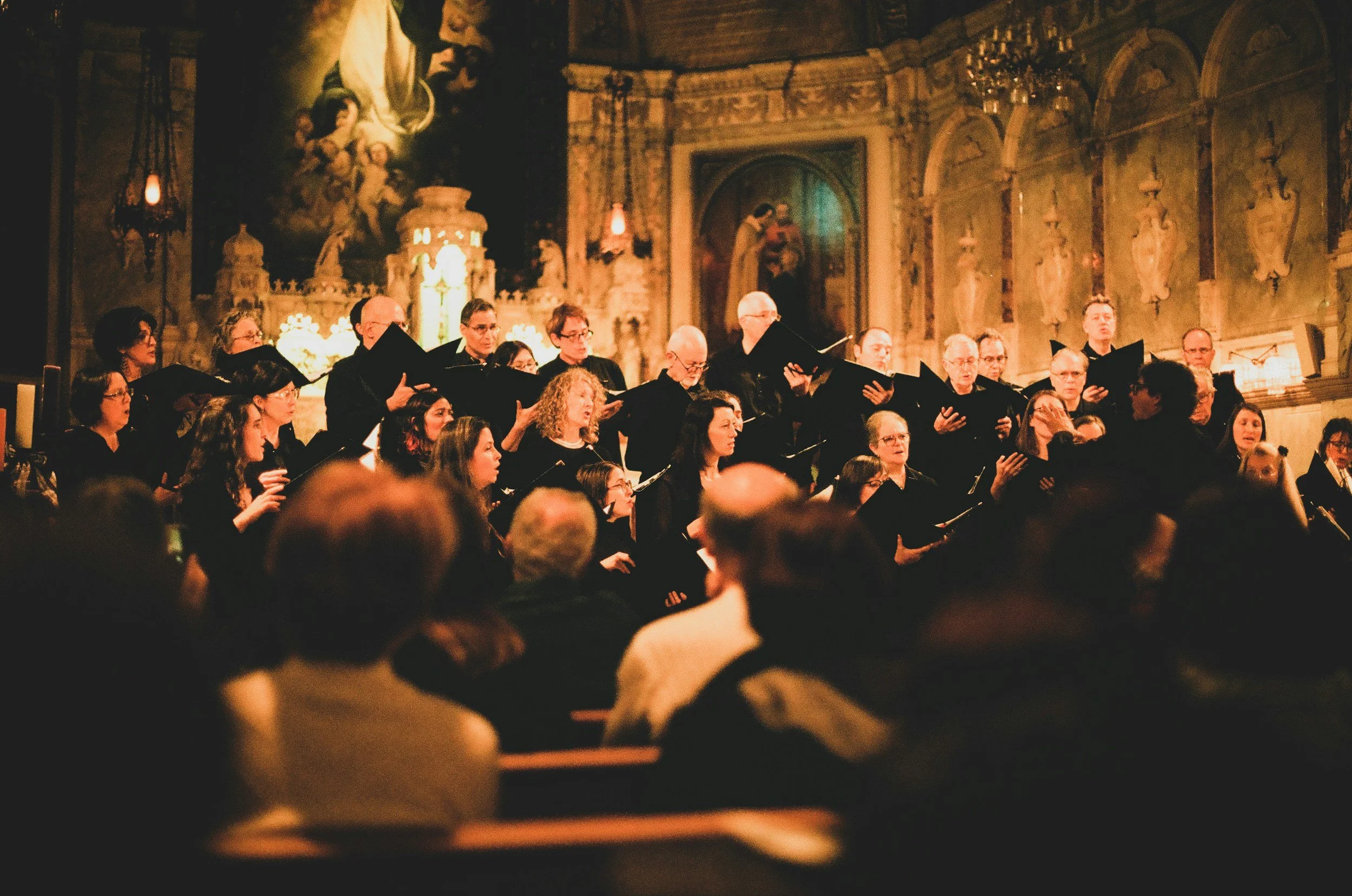
Why does God tell us to sing in our worship? Have you ever thought about that? Is singing really all that different from speaking? Why does God call us to sing rather than say? After all, we recite creeds to great effect. Why not just do slam poetry recitals? Think of how much easier that would be! We would not have to worry about tone deafness! Expensive instrumentation would be unnecessary, there would be no need for musicians to be here every week to lead in song. It would be so much easier, more mobile, and in some churches, questions and preferences about style and tune would not be necessary.
The simple answer is that we sing because God commands us to. We see repeatedly the command to do this (Ps. 95:1-2; 96:1-2; 98:1; 100:1-2; 149:1; Col. 3:16; Eph. 5:19, and many, many others) as well as examples of this in Jesus' ministry and the life of the Apostles (Matt. 26:30; Acts 16:25), as well as the activity in heaven (Rev. 5). So there is no getting away from singing.
While the command to sing would be enough, God is so much more creative than that. God actually does have reasons for everything that He commands us to do, and they are always good reasons. We will see in our passage today that God gives us such a reason for our singing, and thanks to science today, we have even more evidence of God's goodness to us in His commands.
So we are going to be looking at two points today: God receives glory from our singing and God grows us through our singing.
God receives glory from our singing
Singing is such a unique element of our human life. We tend to sing about things that matter to us. Singing is usually prompted by some great emotion whether joy, pride, or sadness, and it is more common in modern life than we may first think. When football season rolls around, we see people singing about their team because they are proud of them! Before the game, we sing about our country. When it is someone's birthday, we don't just say "happy birthday," we sing to them! Even if it means doing so in a crowded restaurant while they wear a silly hat. We sing to mark the special occasions in our lives and often to honor the object of the song whether it is a team, country, or birthday celebrant. We could just as easily speak the lyrics to those songs, but it is undeniable that something is missing.
So when we turn our singing to God, it is prompted by His greatness and His work for us. By singing about Him, we are bringing that unique praise to Him that really only singing does. So it only makes sense that there were all of these passages that I mentioned earlier that command our singing to God. It is a right and proper thing to do given that He has done all of these things for us.
This is why our passage ends with the command that we are to be singing ultimately with thanksgiving in our hearts to God. He is the reason why we sing. He is the one who deserves all the glory that having a song sung about you gives.
But that is not where we will spend most of our time today. This isn't because this aspect of it is unimportant. After all, we are in a series on worship that is ultimately for God! But I don't think that you need to be convinced that there is something happening between you and God when you sing. If you remember a few weeks ago, we had to remind ourselves that the worship doesn't stop when the musicians do. When the pastor starts preaching, the worship is ongoing.
Instead, where I would like to spend our time is in the first parts of our passage today, because I think this is the part that we miss the most.
God grows us through our singing
Let's look at Colossians 3:16 closely. To set up where we are, this is a letter to the church at Colossae to correct some false teaching and was likely written around the same time that the letter to the Ephesians was written. Paul in this chapter 3 has been laying out what the people of the Lord are like, not tied to any ethnic identity but rather are defined by their putting off their sinful life and embracing their new life in Christ. This life is one of moral behavior, forgiveness, and above all, love.
Now to verse 16.
Our first phrase is, "Let the word of Christ dwell in you richly," This command is fairly straightforward. We want to have the teachings of Jesus and the truth about Himself to be a part of us. It has this idea that if Jesus is going to dwell in a place, He is going to control the place. That makes sense so far.
The second phrase is "teaching and admonishing one another in all wisdom." Again, another fairly straightforward phrase. We don't use the word "admonish" much anymore, but it has the idea of correction and warning. If you are running towards the ocean to go swimming and someone yells out to you, "Stop! There is a shark nearby!" That is a warning and a correction: "Your behavior is bad, if you want to live! You better stop!" That is what we are called to do in the Church for each other, in all wisdom, and, as one commentator points out, in the context of love and forgiveness that the rest of the chapter outlines for us.
The third phrase is where the surprise comes in. We might think that the teaching and admonishing one another comes through Bible studies and small groups. But that is not what the verse says. Instead, this teaching and admonishing comes through singing with thanksgiving to God for all things.
Didn't see that coming did you?
"Well, now, hang on a minute," you may say, "how can you be so sure that this is what the text is saying?" Well, the best commentary on Scripture is Scripture, and for that we go to Ephesians 5:19. In this chapter, the same set up occurs. Paul is writing about the new family of God not defined by ethnic lines but defined by moral behavior that puts off sin and puts on righteousness and above all love, and then we get to verse 18-21, "And do not get drunk with wine, for that is debauchery, but be filled with the Spirit, addressing one another in psalms and hymns and spiritual songs, singing and making melody to the Lord with your heart, giving thanks always and for everything to God the Father in the name of our Lord Jesus Christ, submitting to one another out of reverence for Christ."
Sound familiar?
I think Paul is talking about the same thing here. When we sing, we aren't just singing to God, though again, that is primary. We are also singing to each other, teaching each other, as well as warning each other. In a phrase, when you all sing, that is your chance to preach.
And your brain is in a different mode when you are singing versus you are just listening to me. Singing is one of the few things that uses your entire brain to process it. According to one neuroscientist, who also happens to be a Christian, the melody, sound, and seeing people's facial expressions starts at the back right of the brain and moves forward. This is the side where joy and relational connection is built, but the words aren't processed here, yet. That is a left-brain thing, so the process takes a turn behind your right eye and moves to the left side of the brain and begins the backward journey to interpret the words that we just heard and sung (The Other Side of the Church, Jim Alexandar). This is your brain while singing.
It is then no wonder how things just stick better when we sing them. Advertisers know this. I heard a jingle for Empire carpet twenty years ago, and I still remember their phone number.
God knows this, too. That's why so many of the Psalms, the Bible's hymnbook, contain accounts of God's great deeds for Israel in them. They were a way to remember all the great things that God has done for them and a way to pass down from generation to generation these truths.
So what does that mean for us?
We have a responsibility to sing, and to sing well-thought-out music. This is how we teach and encourage each other. What else are we doing when we sing "Be Still My Soul"? Many of us can't get through verse three, which says, "Be still my soul when dearest friends depart/and all is darkened in this vale of tears/Then shall you better know his love, his heart,/Who comes to soothe your sorrows and your fears./Be still, my soul, your Jesus can repay/From his own fullness all he takes away." So many of us in here are in both places of needing comfort because of people we lost and giving comfort to others who have lost. That's what we are doing when we are singing. When we sing of the mighty fortress we have in God, we remind each other not to trust in lesser things.
Words like that get in our minds and come back out when we need them. That is why it is so important for us to sing good things, Biblically accurate things, things that will stick with us. This is why I am trying to introduce Psalms into our worship as well. I want you to be discipled by these things. It isn't to say that we can only sing Psalms. It isn't even to say that we cannot sing more modern things either.
There is an obscure hymn that the Gettys revived a while ago called "Facing a Task Unfinished." It was written in 1931 by a missionary trying to raise up 200 more missionaries to go to China during a difficult time in its history. Listen to this first verse: "Facing a task unfinished
That drives us to our knees/ A need that undiminished/Rebukes our slothful ease/We, who rejoice to know Thee / Renew before Thy throne/The solemn pledge we owe Thee/To go and make Thee known" then they add the chorus "We go to all the world/ With kingdom hope unfurled/No other name has power to save/ But Jesus Christ The Lord" Perfect gut punch admonishment, followed by encouragement to carry out our mission.
So sing. Sing with gusto, you're preaching! Listen with intent. You're being preached to. Do it with a grateful heart, because above all, God is listening with joy.