
Jesus: The Prophet
Open Bible with red ribbon on top
Photo by Tim Wildsmith on Unsplash
As you're being seated, if you would, please turn with me in your copies of God's word to Acts chapter 3, Acts chapter three, we will be looking at verses 17 through 26, although we'll be tracing this theme a little bit through the Bible itself. We've already read the Old Testament mention of this, the first time it's shown up. And here we're seeing it here in the New Testament.
If you're following along in the Pew Bible, the black volume that's in front of you that's on page 10083. 10083. To give you the brief context here, Peter is giving a sermon to a crowd that is gathered together because they have just healed a man who has paralyzed his whole life and has been sitting at this gate begging alms, and now all of a sudden he can walk around, jump around as praising God, and Peter is explaining how it is that this is possible.
Of course, is the power of Christ that is evident in this man's life. The man that this crowd was at least joining in crucifying him. And that's where we pick up in verse 17, Acts chapter 3.
Listen carefully, because this is God's word. And now, brothers, I know that you acted in ignorance, as did also your rulers. But what God foretold by the mouth of all the prophets that this Christ would suffer, he thus fulfilled, repent, therefore, and turn back that your sins may be blotted out, that times of refreshing may come from the presence of the Lord, and that he may send the Christ appointed for you.
Jesus, whom heaven must receive until the time for restoring all the things about which God spoke by the mouth of his holy prophets long ago. Moses said, the Lord God will raise up for you a prophet like me from your brothers. You shall listen to him and whatever he tells you, and it shall be that every soul who does not listen to that prophet shall be destroyed from among the people.
And all the prophets who have spoken from Samuel and those who came after him also proclaimed these days.You are the sons of the prophets and of the covenant that God made with your father, saying to Abraham and in your offspring shall all the families of the earth be blessed. God, having raised up his servant, sent him to you first to bless you by turning every one of you from your wickedness. This is the word of the Lord. Thanks be to God for His Word.
Let's go to our God and ask His blessing on our text today. Oh, heavenly Father, you who have given to us your eternal Word, not only what we have just read, but in the person in whom this is about, we pray that we might look at this word with a greater clarity, and a greater love than we have before, but I pray that you had blessed the preaching of your word, pray that you had commended to the hearts of all of us, that we might love you more.
Oh, we ask all these things in Jesus' name. Amen.
Who is Jesus? Who is he fully? There has been a recent survey that's gone out. It's called the State of Theology Survey, where they're asking people, both your average everyday Americans and even your regular churchgoing folk, a series of questions as to what is the Bible? Who is Jesus and this sort of thing. And one of the things that was amazing is when they asked the question, who is Jesus?
Is he just a great teacher? And what we found was that at least, I think it was 20% of even church going folks, would say that yes, he's just a teacher. He's not God. But is meant to give us an example as to what we're to follow. Well, like most lies that are damaging, there is a bit of truth. Yes, Jesus has given us an example.
Yes, he was a great teacher, but that's not all he was either. We can also make the mistake, especially when we come to our seasons of Advent, when we see little manger scenes everywhere that we see Jesus as the baby. The harmless little thing that we've all come to worship and adore.
And we forget that there is a lot more to this baby as well. In theology, there is a term that's given that Christ occupies three offices, which is just a fancy way of saying that God has the Son of God Jesus, has three titles, three things about him, three jobs that he occupies to help us in our Christian life, to show us the way. And those three offices are prophet, priest, and king.
And as those three jobs of Jesus, his full nature is what we are going to be examining this Christmas season, that he is the prophet. So what we're going to do is that we are going to look at our two points as we examine Christ's character today, if you will do the note-taking sort of person. The first is that Christ is the ultimate prophet.
Christ is the ultimate prophet. But what we're going to see is that he is the message. He is the message or the word.
So let's take a look. Christ is the ultimate prophet, and let's answer the question, what is a prophet? There's a lot of misunderstanding as to what a prophet does, because when we hear about prophets, it's usually stuff that they said a long time ago, that's only just now coming true.
So we tend to look at prophets as future tellers, predictors. And while that's probably the most impressive thing that they do, that's not the only thing that they do. It's true whenever, usually, when we're reading from Isaiah, we're only reading about the predictions that he's made, that a virgin will conceive and bear a son, you shall call his name Emmanuel, and that's Isaiah chapter 7, "We don't see that verse fulfilled fully for another 700 ish years when we see Jesus, who is indeed born of a virgin and is given the name Emmanuel, meaning God with us.
And while he does that in several places in the book of Isaiah, that's hardly the majority of what Isaiah is doing. The majority of what Isaiah is doing is not giving you new information, but is reminding you of information that God has already given. There is a law!
You are to worship only God, not to make these idols of wood. Instead, ye to repent of that sort of false worship, and then turn to the god who is thrice holy. That's the main message of Isaiah.
And yes, also prediction, in there as well. There is some fore telling, looking forward to the future, but the majority of what the prophets are doing is forth-telling, laying out God's laws. Now, who were these prophets?
Well, the one that acts chapter 3, mentions, of course, is Moses. Now, Moses comes up again, in this particular concept comes up again in Acts chapter 7, just a few pages over. When we look at Acts chapter 7 and beginning, there in verse 20, we see this is coming up in the context of a sermon.
Here in Acts chapter 7, we hear hearing from one of the first deacons of the church. His name is Stephen. And he's being brought in front of these religious leaders to give an account of what it is that we're teaching, what it is that we're preaching, and he is going through as we were to read the entire thing, which we do don't have time to do this morning.
What he is doing is going through a history of the Old Testament and saying,Here is what your fathers have done to the prophets, and how well they have listened to said prophet. He introduces Moses's life, and if we were to read this whole passage, I would encourage you to do so at home later today versus 20 through 45 He lists out Moses, and all the things that he did, but how often he was ignored. Even at the very beginning of his life, and the very beginning of his ministry, so to speak, this first deliverance is delivering one of the Hebrew slaves from an excessive beating from one of the Egyptians. In the account and Exodus, which Moses himself is writing, says he looks this way, and that left and right, and kills one of the Egyptians and buries him in the sand. And then when he comes up and sees there's an argument the next day between two Hebrews, he comes up to them and says, hey, how can we sort this out? And it says they're in acts that he was thrust aside and saying, "Who have you have made you judge over us?"
And we'll see that pop up here, and again and again in this chapter, Moses is thrust aside. And back in Deuteronomy, he is saying, there's going to be a prophet that's going to be raised up after me, and you shall listen to him. What we see in Acts chapter 7 in this fulfillment of it, that there hasn't been listening. Look at verse 42, but God turned away and gave them over to worship the hosts of heaven, as it is written in the book of the prophets, did you bring to me slain beasts and sacrifices during the 40 years in the wilderness? Oh house of Israel? You took up the tent of Moloch, and the star of your god Rephan, the images that you made to worship.
I will send you into exile beyond Babylon. Here, they did not listen. They thrust Moses aside.
They did not offer up true worship to the only God, which was the first and second commandments. The law was thrust aside. And indeed, as we are seeing here, and we get to the rest of this chapter, the one who was to be raised up a prophet like Moses, Jesus is thrust aside as well.
And he is killed. This is how these prophets were treated. And we will see this throughout the rest of the Old Testament if we were to look at them, we were to see these sorts of prophets after Moses, there were many others that were raised up.
There was another great prophet, and his name was Samuel, that he would be the one who was one of the kind of the first prophet and judges of pulling the people together and trying to bring more people into conformity to God's Word. But as we would see in the tragic life of his sons, Samuels even his own sons, don't follow him. Eventually, Samuel is rejected in favor of a king instead.
Or Isaiah, probably one of the greatest prophets, at least in terms of Britain volume of what he is calling of his people to turn and repent, he's thrust aside, too. In fact, in Hebrews chapter 11 32 and 38, it says that some of the prophets were put inside of a log and sawn in two. The tradition is that's Isaiah. It doesn't get more thrust aside than that! God's prophets all the way through the Old Testament were ignored, because they continued to bring God's word and the people continued to not want to listen.
But the prophets were limited.
You might be able to say if we were going to try to if we were the ones in the sights of this complaint, we were ignoring the profits because it was like, well, these profits were flawed men too. Why should we listen to them? Who made them judge over me? I don't want to listen to this sort of a thing. I know their sins. I know Samuel's sons don't follow him.
Well, here we get into the New Testament, we get the ultimate word as sent. Christ, He's the ultimate prophet. He's not only telling the future, we've seen places like Matthew 24., but he's also laying out God's law in Matthew 5 7 says, here is what the law looks like. Here's what it always was meant to be, to call them to this great standard of holiness, but do you know what's fascinating when he talks versus when all the other prophets would talk? When the other prophets would talk, they would need to have a preface. They would need to say, thus saith the Lord, to give authority to what they're saying.
They couldn't just get up there and saying, "Hey, guys, you know, this worship of Vail, it's just not practical." You see, it just doesn't work. They're not offering their own wisdom.
They have to cite their source of thus saith the Lord. What is Jesus say? This is truly, truly, I say to you, what an audacious claim. To say, I am going to speak for God, because he is. That's one of the things that you will see throughout the New Testament when the people are reacting to Jesus, they'll say, no one teaches like this guy. All the other scribes in the Pharisees, they have to keep referring back to other authorities.
He's speaking on his own authority. Well, how do you get to say that? How do we know?
if you are there in the first century listening to Jesus, we've had lots of people come and claim to be prophets of God. And they were wrong. How do we know?
In Deut. 18, a little further down, there is a test. Saying there's, if a prophet is going to say something, and that it doesn't turn out to be true, you can ignore him. You're going to test things against God's word. That's exactly what he did. When he is saying, I'm I'm I'm going to be risen from the dead in three days' time, and what do you know? He's risen again, three days' time, just as he said. When he says, "You are healed, rise and walk, and the man is healed and rises and walks." Miracle after miracle after miracle, authenticating what it is that he's saying. He is a trustworthy prophet, the ultimate prophet, but he goes beyond this.
He is able to do all of these things by his own power. The prophets couldn't do that. They couldn't force a conversion.
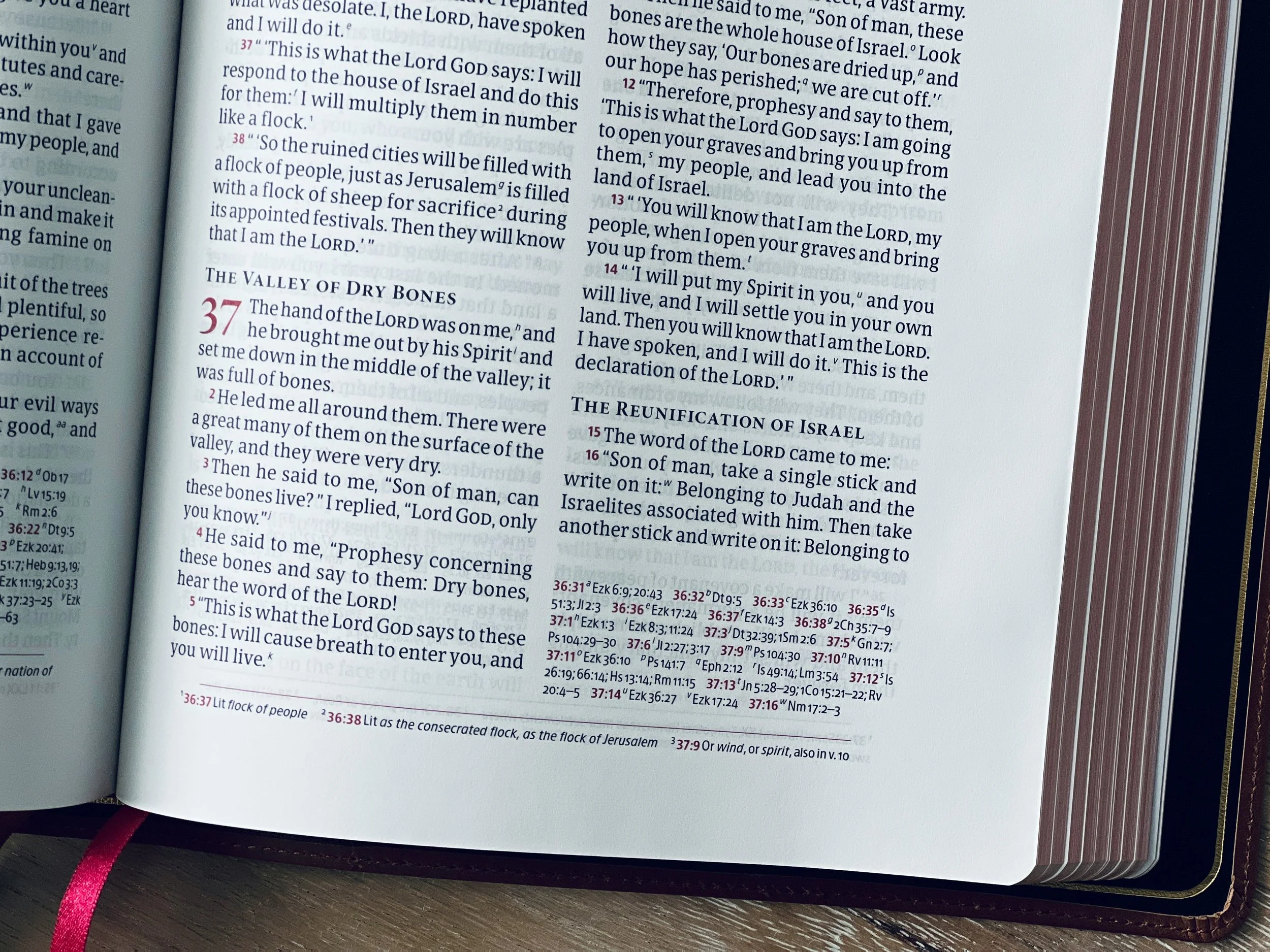
There's a wonderful story in Ezekiel 37, another one of God's Old Testament prophets. Ezekiel is brought to this field of bones that are all dried out. And Jesus the Lord asks Ezekiel and says, "Can these bones live?" And Ezekiel goes, "Lord, you know," which is a great way of sidestepping the question. Because all he is saying is, Lord, you know the answer to that. And that's not what God said, is it? He doesn't know. His answer might be. It's like, well, looking at the situation, the answer is no. These bones can't live again." But he says, "Lord, you know. Because with the Lord, all things are possible, and God tells Ezekiel to preach to the bones, and he preaches to the bones, which must have felt silly. I've had to preach to people who were asleep, but I've not had to preach to people who were dead.
And then it says that there is a mighty wind that comes together, and animates these bones, brings them together, puts flesh on them, and ultimately, breathes new life into them so that they're raised again. Does that come from Ezekiel? No. Nothing comes out of Ezekiel. He's just talking. But it's God that moves and raises these from the dead. Now, what happens when Jesus wants to raise somebody from the dead? There a mighty rushing wind? No. It's his word. It's his breath that calls Lazarus out of the tomb. It's his touch that heals, and its power that comes from him when the woman touches the hem of its garment, it's not power that's come from exterior. He says, I felt power come out with me. He is the source.
And that's where we get into our second point, is that Jesus, Christ, is the Word. When he is coming and preaching, he is not like Isaiah. Isaiah is pointing elsewhere and is saying,Over here is the word of God. Follow it and obey." When Jesus is speaking, he says, "I am the Word. I am the bread, taste, and see. This is a very different prophet. This is not one that you are just listening to him. You are not listening just to the teaching that he's given. But shockingly, in John chapter 6, this is the prophet that you eat. That's weird. And it's intentionally so.
Jesus is pointing out, I'm not like the rest of them. Yes, there is a prophet that is like Moses, but is much greater. Yes, Moses could bring the law of God down. Jesus comes down. He says, I am God's word to you. This is not written on a tablet of stone. It's spoken out of human mouth. And it's me, and it's not just following what I say. It's becoming who I am.
This is what it means for Jesus to be a prophet. So when we hear the question, was Jesus just a teacher? The answer is a resounding no. Yes, he taught! Yes, he proclaimed God's word! But he was far more than that. He was the Word, and he calls you to it. The question, of course. is what are you going to do about it? That has always been the choice. That has always been what's on offer here, all through the Old Testament is God calling his people to himself. And Jesus is doing the same. He's offering out His Word to you, "We are sinners. We are rebellious. We deserve judgment. But just like all the other prophets of the Old Testament, there's an offer of grace, that there will be one by whose stripes you will be healed.
Here in the New Testament, we get to see what this is. This calling, not to a way of life, but to a person, and to say, come, follow me, and I will give you rest. So what are you going to do this Christmas? How are you going to look at this prophet? Are you going to, like many, did in the past, thrust him aside, like Moses?
There could be a lot of ways you can do that.
It can be, I do not like God's demands on my life. I do not like what this is going to mean for me because things are going to have to change. We can thrust him aside that way. We can also thrust him aside by saying it's like, I really don't need that Jesus. My life is already pretty moral. I'm actually living a pretty good life. I don't need this grace. I prefer to do things myself. Well, Jesus has already proclaimed that we are sinners.
It's not about living a moral life alone. This is about submitting to Christ, acknowledging that we are in fact, sinners, and we do in fact need this grace. So we can thrust him aside by saying, I don't want to be holy, or we can thrust him aside saying, I'm already holy, thank you."
But doing that is to ignore the word that he's given. And this is the last word that we have.
In the book of Hebrew, and we'll close with this, in the book of Hebrews in chapter 1, the writer is opening by saying that in many ways, in various times, God has spoken to us by the mouths of the prophets. But in these last days, he has spoken to us by his Son. This is as clear of a revelation as we could possibly ever have.
When you look through the Old Testament, you'll find these prophets get increasingly theatrical. It's like there's this a deeper and deeper display of what God's word is. You'll hear Isaiah is talking and is preaching, but you get to Ezekiel, and he is like lying on his side for three years, chaining himself up with this ox goad. It looks kind of theatrical, but God's word is getting clearer and clearer and clearer. You weren't listening by words. I'll give you visual aid.
You're not listening to the prophets, let me send my son to you.
There is a message given by one of my favorite preachers, Neil Stewart, who talks about the life of Christ. And he says, "I can imagine in every single moment of Jesus' life, all the angels are going back and are looking down on him and are saying, "Ah, he's just like his father.
He's the perfect revelation of God. Every word, every tone of voice, every facial expression, is all the perfect revelation of God, the Father, and his heart towards his people. We are not just coming to Jesus, fearing judgment or thinking, "Well, the Father's really angry at me, so I better shape up." Though the Father has the same beating heart as Christ. The one who dines with sinners and it compels them to come in. That's why he's the ultimate prophet.
No, Isaiah couldn't dream of being like that. The beginning of his ministry, he says, "Woe is me, I'm a man of unclean lips!" Jesus comes, he's the perfect example.
No sin, no flaw. And then offers himself on a cross, and then by faith, in a spiritual sense, he offers lunch, Supper. And he calls us to his table.
And they're saying, you've heard this word. You've seen it, if you happen to be there in the first century, revealed to you on earth. And now, today, we see His Word at the table, in bread and fruit of the vine. A picture of a body broken of blood spilled. So as we come to the table this morning, let's be reminded, God has spoken to us in as many ways as is possible.
He is spoken by His prophets. He has sent his son, he's given us visual aid, He's given us written words. We have every possible way of seeing and hearing God's word.
Will you listen? Will you hear? Will you taste and see that the Lord is good?
Let's pray. Heavenly Father, we thank you for this great word that you've given to us, this clear, window into your own soul, into your heart, that we can see that you love your people, and that you desire fellowship with your people. The name that you chose coming to earth was Emmanuel, God with us, and you are with us.
So, Lord, now, we desire fellowship with you. We ask that you would meet us here in this moment, in this solemn celebration of the Lord's Supper. Help our hearts to be prepared to receive such a gift.
Lord, we ask all of these things in Jesus' name. Amen.